Articles to inspire
Back
What Thomas
Merton and Muhammad Ali had in common
Lonnie Ali
The New York Times, January 17, 2017
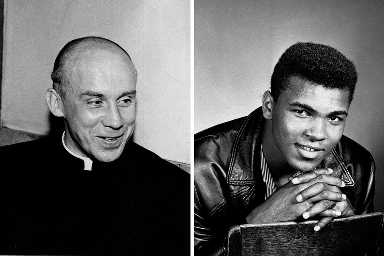 On an afternoon in 1958, near the
shopping district at Walnut and Fourth Streets in Louisville, Ky., Thomas Merton was
moving about inconspicuously gathering supplies for the Abbey at Gethsemani. The
monastery, established in 1848 by the Order of Trappist Cistercians, is in Nelson County,
south of Louisville near Bardstown. It is where Merton lived as a Trappist monk beginning
in 1941.
On an afternoon in 1958, near the
shopping district at Walnut and Fourth Streets in Louisville, Ky., Thomas Merton was
moving about inconspicuously gathering supplies for the Abbey at Gethsemani. The
monastery, established in 1848 by the Order of Trappist Cistercians, is in Nelson County,
south of Louisville near Bardstown. It is where Merton lived as a Trappist monk beginning
in 1941.
Merton’s
autobiography The Seven Storey Mountain, published in 1948, and other works on
interfaith dialogue, peace and nonviolence had made him an international best-selling
author. The Washington Post would later call him the most significant Catholic writer of
the 20th century. In an address to Congress, Pope Francis described Merton as a thinker
“who opened new horizons for souls and for the church” and “a man of
dialogue, a promoter of peace between peoples and religions.”
That
afternoon on Walnut Street Merton had a revelation that, according to his biographer,
William H. Shannon, caused him to rethink the separateness of his life at the abbey.
Merton experienced “the glorious destiny that simply comes from being a human person
and from being united with, not separated from, the rest of the human race.” It was
as if, Merton himself said, “I suddenly saw the secret beauty of their hearts.”
Merton would emerge from the confines of the abbey and become a significant figure in the
1960s social justice movement.
Twenty
years later, in 1978, Walnut Street was renamed Muhammad Ali Boulevard, after my late
husband. In 2008, the intersection at Fourth Street and Muhammad Ali Boulevard was
dedicated as “Thomas Merton Square.” It would have been difficult to predict in
1958 that the divergent paths of the two men would someday be merged in the permanent
markers of the same city street. At the time of Merton’s revelation, 16-year-old
Muhammad was across town delivering his own revelation to a series of opponents on his way
to a gold medal and the World Heavyweight Championship.
It is the
convergence of their message of faith that bears noting as we mark what would have been
Muhammad’s 75th birthday on Jan. 17. Over time, Muhammad’s deep, evolving
devotion to God, whom as a Muslim he called Allah, came to be rooted in his love of all
people. Boxing had taken him around the world and it opened his eyes to the beauty in
diversity. Akin to Merton’s revelation, Muhammad was fond of saying, “the key to
a man’s soul is in his heart.”
Like
Merton, whom he never met, Muhammad was naturally drawn to the power in all faiths and at
his direction his memorial service included an imam and an Islamic scholar, two Baptist
ministers, two Jewish rabbis, a Roman Catholic priest, a Native American tribal chief and
faith leader, and a Buddhist monk. Muhammad famously said, “Rivers, ponds, lakes and
streams — they all have different names, but they all contain water. Just as
religions do — they all contain truths.”
As
America stands divided once again in the aftermath of a polarizing election, we would do
well to follow the example of Thomas Merton and Muhammad Ali in their approach to
diversity, pluralism and faith. Regardless of our differences, we share a common humanity,
something that will always bind us to each other. We must find ways to reconnect to each
other by developing empathy and by giving back. In truth, America has always faced
division in varying degrees. The test for America has always been how she manages her
division, how she finds and clings to a common purpose, and how she spins the tapestry of
her diversity.
Neither
the monk nor the boxer relied on political leaders to set their course in matters of
justice, equality and tolerance. Neither man was elected to high office, but their
messages in print, in words and in deeds reverberated across the globe and in the highest
chambers of power. Although one was a scholar and the other bore no papered credential,
they each challenged convention or, as Pope Francis said of Merton, “the certitudes
of the time.”
Muhammad
was fond of the Buddhist expression, “The only constant in the universe is
change.” He drew on those words to embrace each day and each person he met. Merton
said, “we do not find the meaning of life by ourselves alone — we find it with
another. Happiness is not a matter of intensity but of balance, order, rhythm and
harmony.”
Lonnie
Ali is a philanthropist and chairwoman of “Ali in All of Us,” a campaign to
inspire community service. Her article was reprinted in PeaceMeal, Jan/February 2017.
(In
accordance with Title 17 U.S.C. Section 107, articles in this publication are distributed
without profit to those who have expressed a prior interest in receiving the included
information for research and educational purposes.)
The different worldview of Francis of Assisi
 Richard
Rohr, OFM
Richard
Rohr, OFM
St. Francis was born in
Assisi, Italy, in the year 1181. He died in 1226. It was a time of great social and
economic change and much violence between Italian city-states. Before and during his life,
Europe and the Muslim world were involved in four Crusades, and there were more to come.
Christians were fighting Muslims; Muslims had overtaken what Christians considered their
holy places in Jerusalem; and the Christians of the West were fighting the Eastern
Orthodox Christians. Added to that, Assisi itself was in an ongoing war with Perugia, a
little city to the west.
In the
year 1202, Francis was taken prisoner in a battle against Perugia. In 1204, he escaped
from prison. He emerged dazed, disillusioned, and deeply hoping for something more,
something different than all the terrible violence that had destroyed his youth. His world
was obsessed with war, with security, with self-protection, and with fear of the outsider.
(Does this sound familiar?)
Everyone
in Assisi was armed. Revenge, scapegoating, cruelty, torture and aggression against
enemies were rampant and even socially sanctioned and idealized, much as they are today.
Francis
seemed to realize that there was an intrinsic connection between violence and possessions,
power and prestige. So he rejected all of them. His father was among the first generation
of the new propertied business class. Francis recognized that his father’s obsession
with money and property had destroyed his father’s soul, and so he set out on a very
different path.
Francis
concluded that the only way out of such a world was to live a life of voluntary poverty or
“non-possession.” He refused to be part of the moneyed class because he knew
that once you owned something you’d have to protect it and, for some reason, you
would inevitably try to get more of it. Francis said, “Look, Brothers, if we have any
possessions, we will need arms to protect them.... Therefore, we do not want to possess
anything in this world.”
Francis
believed that in order to find a way out, he had to live in close proximity and even
solidarity with the excluded ones in his society. He literally changed sides. He had been
born among the upper class in Upper Assisi. In the lower part of town lived the lower
class. Francis not only moved to the other side of town, but he actually moved to the
plain below Assisi where there was a leper colony.
“Leper”
did not always refer to the contagious disease. Rather, the lepers in both Jesus’ and
Francis’ times represented the excluded ones, the ones whom society had decided were
unac-ceptable, unworthy or unclean for a number of reasons.
Francis
told us to identify not with the upper class and the climb toward success, power, and
money, but to go to where Jesus went — to where there was pain, to the excluded ones.
We were to find our place not in climbing but in descending, not at the top but at the
bottom, not among the insiders but with the outsider. What an upside down world!
Francis,
seeing the beginnings of the propertied leisure class, told us to work for our pay; and if
work was not available, we were to humbly beg, just as the Buddha advised his monks.
Francis recognized that his society was becoming a structured system of protected and
unequal social relationships. He knew the violence, mistrust, ambition, and pride which
that worldview would engender.
So he
insisted on what he called “equal power relationships” in religious communities.
He rejected all titles like Superior or Abbot. Francis did not want anyone to act as if he
was higher than anyone else. Even those who led the community were to be called friars or
brothers, and they only held the office for a short term and then returned to the equality
of brotherhood. No one should stay at the top for very long; and when they were there,
they were to be servant leaders or “guardians” of the mission and message of the
friars.
In
Francis we see the emergence of a very different worldview, a worldview that is not based
on climbing, achieving, possessing, performing or any idealization of order, but a life
that enjoys and finds deep satisfaction on the level of naked being itself — much
more than doing or having. ...
It seems
to me the Franciscan worldview is now desperately important if the 7.4 billion of us are
going to exist happily together on this one limited planet. Voluntary simplicity is now
essential for social survival. Francis warned us where we were headed eight hundred years
ago.
(In
accordance with Title 17 U.S.C. Section 107, articles in this publication are distributed
without profit to those who have expressed a prior interest in receiving the included
information for research and educational purposes.)
100 Buddhas rise from land to inspire contemplation
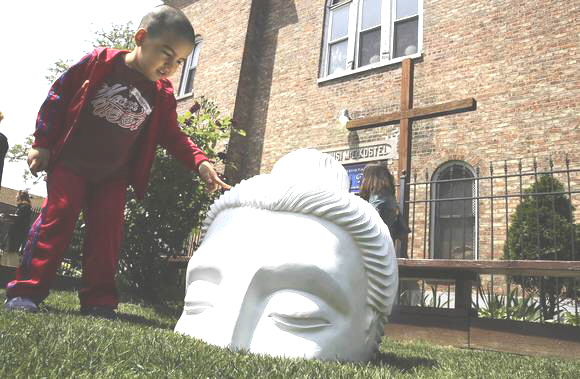 Photo caption:
Pedro Angel Alvarez, 4, checks out the emerging Buddha sculpture Tuesday outside Amor de
Dios United Methodist Church in Chicago.
Photo caption:
Pedro Angel Alvarez, 4, checks out the emerging Buddha sculpture Tuesday outside Amor de
Dios United Methodist Church in Chicago.
Some people believe the
solution to neighborhood violence is increased police presence and arrests. For others,
it’s teaching parents how to raise respectful children. And then there is a small
nucleus of idealists who believe all it takes is art.
That’s
the theory behind Ten Thousand Ripples, a public art project that culminated June 4 when
community activists installed the 100th statue of a partial Buddha head emerging from the
ground beside a rose bush in a Chicago neighbor-hood.
Since
November, 300-pound emerging Buddhas have appeared as if rising out of the earth in 10
neighborhoods across Chicago and in Evanston, Ill. On June 4, activists and the artist
behind it all unveiled the final statue in front of Amor de Dios (Love of God) United
Methodist Church.
“We
think of sculpture being at the Art Institute or gardens,” said Indira Johnson, the
artist and peace educator whose exhibit at the Chicago Cultural Center a couple years ago
inspired the public art project. She noticed how the emerging Buddha caused visitors to
stop and contemplate.
As the
name implies, Ten Thousand Ripples was intended to create just that — waves that
reverberate through each community, sparking conversation, instilling a greater sense of
neighborhood pride and respect for one’s surroundings, and renewing efforts to
improve each community’s quality of life.
Of
course, installing each piece of art was not that simple. Johnson and her partners at the
educational nonprofit Changing World approached community organizations, businesses and
houses of worship to help pinpoint 10 spots in each area where the emerging Buddhas could
have the greatest impact. In addition to selecting sites, community leaders also had to
develop programs that enabled children, senior citizens and families to address the
various issues in their neighborhoods that prevented peace: bullying, gun violence, gangs,
sexuality and interreligious relations, to name a handful.
Some
communities had reservations about sponsoring a Buddhist sculpture. It depended on what
the culture of the community was open to. But most neighborhoods embraced the
sculpture’s universal message of peace.
– edited from an
article by Manya Brachear in the Chicago Tribune, June 5, 2013
PeaceMeal, July/August 2013
(In accordance with Title 17 U.S.C. Section 107, articles in
this publication are distributed without profit to those who have expressed a prior
interest in receiving the included information for research and educational purposes.)
Peace in the heavens, Peace on earth
Rabbi Harold S. Kushner
A prominent Jewish prayer
concludes “May He who made peace in the heavens grant peace to us on earth.”
What does
it mean to create peace in the heavens? Ancient man looked up into the sky and he saw the
sun and the rainclouds. And he would say to himself, “How can fire and water, sun and
rain co-exist in the same sky? Either the water would put out the fire, or the fire would
dry up the water.” How do they get along? It must be a miracle. The sun says,
“If I dry up the rainclouds, as I probably could, the world will not survive without
rain.” The clouds say, “If we extinguish the sun, the world will perish in
darkness.” So the fire and the water make peace, realizing that if either one of them
achieved a total victory, the world could not endure.
When we
pray for God to grant us the sort of peace He ordained in the heavens, this is the miracle
we ask for. How can men and women live together happily? They are opposites; their needs
are different, their rhythms are different. It takes a miracle for them to bridge those
differences and unite the masculine side of God’s image with the feminine side.
How can
Arabs and Israelis learn to live together? Irish Catholics and Irish Protestants? Black
South Africans and white South Africans? It takes a miracle for them to realize that if
they won, if they had it all and the other side had nothing, the world could not survive
their victory. Only by making room for everyone in the world, even for our enemies, can
the world survive.
May God
who showed us the miracle of Shalom, of making room for each other and giving up the
illusion of victory in the heavens, grant a similar miracle to all of us who inhabit the
earth.
Harold
S. Kushner is rabbi laureate of Temple Israel in Natick, Massachusetts. His many books
include “Living a Life That Matters” and the best-seller on the problem of
evil,“When Bad Things Happen to Good People.”
– PeaceMeal,
Jan/February 2013
(In accordance with Title 17 U.S.C. Section 107, articles in
this publication are distributed without profit to those who have expressed a prior
interest in receiving the included information for research and educational purposes.)
The Power of a Candle
Ron Rolheiser, OMI
In South Africa, prior to the
abolition of apartheid, people used to light candles and place them in their windows as a
sign of hope, a sign that one day this injustice would be overcome. At one point, the
authorities began to crack down on this. It became illegal to have a lit candle in your
window, as illegal as carrying a firearm. The irony of this was not missed by the
children. They soon had a joke among themselves: “The government is afraid of
candles!”
Eventually, as we know,
apartheid was overcome. Reflecting upon the forces that helped overthrow it, it is fairly
evident that candles, lit religious candles, were more powerful, ultimately, than were
firearms. Hope is more powerful than any army.
But what is hope? Many of us
mistake wishing for hope. They are not at all the same. Wishing is fantasy, ure and
simple. Thus, for example, I can wish that I might win a million dollars, but that is not
connected to any reality. It is simple daydreaming. We do not light a candle for a
daydream.
Hope is
based upon a promise, the promise of God, a promise that says that—human sin and
power notwithstanding—justice, peace, love, harmony, gentleness and graciousness
will, eventually, become reality. To light a candle, then, is to say that gentleness and
graciousness are ultimately more powerful than threats, torture and guns. To light a
candle is to proclaim to the world that our real allegiance is given to something and to
someone beyond them.
In
retrospect, the government’s paranoia about candles was well-founded. A lit candle is
a powerful statement of hope.
Ronald
Rolheiser, OMI, is a Catholic priest, author and president of the Oblate School of
Theology in San Antonio, Texas. See: www.ronrolheiser.com
(In
accordance with Title 17 U.S.C. Section 107, articles in this publication are distributed
without profit to those who have expressed a prior interest in receiving the included
information for research and educational purposes.)
 ‘Actions
speak louder than words’
‘Actions
speak louder than words’
Janet Griffin
“Preach always. Use
words if necessary.”
This
saying is attributed to St. Francis, who was a famous preacher. But most of all, he was a
doer. He embodied a ministry that remembered Jesus didn’t say, “Repeat after
me;” he said, “Follow me.”
There’s
a vow in the baptismal covenant of my denomination: “Will you proclaim by word and
example the Good News of God in Christ?” Proclaiming the Good News by example is as
simple as inviting someone to a meal, or sitting at a bedside, or teaching someone to
read, or buying malaria nets, or reducing our carbon footprint. Acts of compassion,
forgiveness, sharing and healing all proclaim the Good News that we follow our God who is
compassionate, forgiving, generous, and the one who refreshes, renews and ultimately
resurrects us.
Acts of
proclaiming Good News also can be as dramatic as a scene on the evening news a few years
ago when Lebanon was torn by warfare. With isolated civilian populations in dire need of
medical help, and the bridges blown to smithereens, members of Doctors Without Borders
formed a human bridge across a river. They stood in the swirling waters of human chaos and
passed supplies, hand to hand, to bring healing and hope to those in need.
If I lack
the courage or strength to stand in those waters, I at least can join in their bringing
Good News by curbing my appetite for trivial things and writing a check to support their
work.
In the
everyday world, there are endless opportunities to show kindness, offer forgiveness,
bestow blessing, share resources, give time and care, and nurture hope. These acts of
compassion are better understood than sermons!
I
don’t need to preach in order to proclaim Good News, because there are so many ways
to live as God’s person in the world.
The
Persian poet Rumi, a 13th-century Islamic theologian and mystic, wrote: “Let the
beauty we love be what we do. There are hundreds of ways to kneel and kiss the
ground.”
Janet
Griffin is rector at All Saints Episcopal Church in Richland. Her full article appeared in
the Tri-City Herald, 17 October 2009 and, edited here, in PeaceMeal, Nov/December 2009.
(In
accordance with Title 17 U.S.C. Section 107, articles in this publication are distributed
without profit to those who have expressed a prior interest in receiving the included
information for research and educational purposes.)
Creativity as one antidote to violence
Are creative persons less
violent than others?
Generally speaking, yes.
Because violence despoils the aesthetic order that creative persons value and, more
importantly, because creating beauty of any kind helps mellow the spirit inside the person
who is creating it.
We cannot
will ourselves into being good people. We can’t just decide that we will be happy,
loving and nonviolent any more than we can decide never again to be bitter, spiteful or
angry. Willpower alone hasn’t got that kind of power. Only an influx into our spirits
of something that is not spite, bitterness or anger can do that for us. Whether we call
this grace or peace or something else, it is what transforms and empowers us to live
caring lives.
Our own
creativity can be a source of what transforms us. The experience of being creative helps
instill in us an appreciative consciousness and satisfaction of sharing in the creative
power of God.
Creativity
is not about public recognition or outstanding achievement. It’s about
self-expression, about nurturing something into life, and about the satisfaction this
brings with it. Creativity can be as simple as gardening, sewing, raising children, baking
bread, keeping a journal, being a teacher, being a scout leader, coaching a team, doing
secret dances in the privacy of our own room, fixing old cars, or building a deck on the
house. It doesn’t have to be recognized by anyone else. We only have to love doing
it.
– edited from a column
by Ron Rolheiser OMI, May 10, 2009
Peacemeal, May/June 2009
(In
accordance with Title 17 U.S.C. Section 107, this material is distributed without profit
to those who have expressed a prior interest in receiving the included information for
research and educational purposes.)
Power of positive thinking
Choose your reality
Lama Chuck Stanford, Rime
Buddhist Center & Monastery
Unfortunately it is not
always possible to change a situation. There are those who must cope with chronic illness,
chronic pain or the death of a loved one. These are situations that can’t be changed,
but what we can change is how we relate to those situations, and that can make all the
difference because the way that we view our world affects our experience.
There are
three universal principles that affect our view of the world: 1) Reality is created in the
moment. 2) In each moment there are multiple realities. 3) What we choose to focus upon
becomes our reality. The Buddha expressed this concept when he said, “We are what we
think. All that we are arises with our thoughts. With our thoughts we make the
world.”
Meditation
also can affect how we view the world. A daily meditation practice awakens our compassion
and introduces us to a far larger view of reality. When we see the world in a more
spacious way, it opens us to new possibilities. His Holiness the Dalai Lama said, “If
we have a positive mental attitude, then even when surrounded by hostility, we shall not
lack inner peace. On the other hand, if our mental attitude is more negative ... then even
when surrounded by our best friends, in a nice atmosphere and comfortable surroundings, we
shall not be happy.”
–
The Kansas City Star, Missouri
PeaceMeal, May/June 2008
(In
accordance with Title 17 U.S.C. Section 107, this material is distributed without profit
to those who have expressed a prior interest in receiving the included information for
research and educational purposes.)
 What the Amish are teaching America
by Sally Kohn
On October 2, 2006, Charles
Carl Roberts entered a one-room schoolhouse in the Amish community of Nickel Mines,
Pennsylvania. He lined up ten young girls from the class and shot each of them at point
blank range. The gruesome depths of this crime are hard for any community to grasp, but
certainly for the Amish who live such a secluded and peaceful life, removed even from the
everyday depictions of violence on TV. When the Amish were suddenly pierced by violence,
how did they respond?
The
evening of the shooting, Amish neighbors from the Nickel Mines community gathered to
process their grief with each other and mental health counselors. As of that evening,
three little girls were dead. Eight were hospitalized in critical condition. Two more girl
have since died. According to reports by counselors who attended the grief session, the
Amish family members grappled with a number of questions: Do we send our kids to school
tomorrow? What if they want to sleep in our beds tonight; is that okay? But one question
they asked might surprise us outsiders. What, they wondered, can we do to help the family
of the shooter? Plans were already underway for a horse-and-buggy caravan to visit Charles
Carl Roberts’ family with offers of food and condolences. The Amish don’t
automatically translate their grieving into revenge. Rather, they believe in redemption.
Meanwhile,
the United States culture from which the Amish are isolated is moving in the other
direction — increasingly exacting revenge for crimes and punishing violence with more
violence. In 26 states and at the federal level, there are “three strikes” laws
in place. Conviction for three felonies in a row now warrants a life sentence, even for
the most minor crimes. For instance, Leandro Andrade is serving a life sentence, his final
crime involving the theft of nine children’s videos — including
“Cinderella” and “Free Willy” — from a Kmart.
Similarly,
in many states and at the federal level, possession of even small amounts of drugs trigger
mandatory minimum sentences of extreme duration. In New York, Elaine Bartlett was just
released from prison, serving a 20-year sentence for possessing only four ounces of
cocaine. This is in addition to the 60 people who were executed in the United States in
2005, among the more than a thousand killed since the reinstatement of the death penalty
in 1976. And the President of the United States is still actively seeking authority to
torture and abuse alleged terrorists, whom he consistently dehumanizes as rats to be
“smoked from their holes,” even without evidence of their guilt.
Our
patterns of punishment and revenge are fundamentally at odds with the deeper values of
common humanity that the tragic experience of the Amish are helping to reveal. Each of us
is more than the worst thing we’ve ever done in life. Someone who cheats is not
only a cheater. Someone who steals something is not only a thief. And someone who commits
a murder is not only a murderer.
The same
is true of Charles Carl Roberts. We don’t yet know the details of the episode in his
past for which, in his suicide note, he said he was seeking revenge. It may be a sad and
sympathetic tale. It may not. Either way, there’s no excusing his actions. Whatever
happened to Roberts in the past, taking the lives of others is never justified. But
nothing Roberts has done changes the fact that he was a human being, like all of us.
We all
make mistakes. Roberts’ were considerably and egregiously larger than most. But the
Amish in Nickel Mines seem to have been able to see past Roberts’ actions and
recognize his humanity, sympathize with his family for their loss, and move forward with
compassion — not vengeful hate.
We’ve
come to think that “an eye for an eye” is a natural, human reaction to violence.
The Amish, who live a truly natural life apart from the influences of our violence-infused
culture, are proving otherwise. If, as Gandhi said, “an eye for an eye makes the
whole world blind,” then the Amish are providing the rest of us with an eye-opening
lesson.
Sally
Kohn is Director of the Movement Vision Project at the Center for Community Change and
author of a forthcoming book on the progressive vision for the future of the United
States. Her article was published on CommonDreams.org.
(In accordance with Title 17 U.S.C. Section 107, this material
is distributed without profit to those who have expressed a prior interest in receiving
the included information for research and educational purposes.)
The Jesus we haven't followed
When will Christians take his teachings seriously?
By Alvin Alexsi Currier
 This
article is excerpted from a sermon Alvin Alexsi Currier preached to expatriate Americans
at St. Andrews Anglican Church of Lakeside, Jalisco, Mexico on August 21, 2005. He writes,
“The sermon was very well received by about half of the congregation. Another third
or so remained sort of neutral or didn’t quite understand what was happening. And
about twenty percent exploded. Actually they ended up by shooting themselves in the foot,
in that they forbid that the sermon be posted on the church website or published in
hardcopy. This censorship is stirring up a bit of a storm, with people seeking copies of
this ‘censored sermon’ to see what it is all about.”
This
article is excerpted from a sermon Alvin Alexsi Currier preached to expatriate Americans
at St. Andrews Anglican Church of Lakeside, Jalisco, Mexico on August 21, 2005. He writes,
“The sermon was very well received by about half of the congregation. Another third
or so remained sort of neutral or didn’t quite understand what was happening. And
about twenty percent exploded. Actually they ended up by shooting themselves in the foot,
in that they forbid that the sermon be posted on the church website or published in
hardcopy. This censorship is stirring up a bit of a storm, with people seeking copies of
this ‘censored sermon’ to see what it is all about.”
Teachings
about Jesus are alive and well in our churches. What haunts me is the question:
What has happened to the teachings of Jesus?
Is Jesus
not the one who warned that it was easier for a camel to go through the eye of a needle
than it was for a rich man to enter the Kingdom of God? Is he not the one who admonished
Peter: “Put your sword back into its place; for all who take the sword will perish by
the sword”? Did he not command us to love our neighbor as we love ourselves?
What has
happened to these teachings? The answer to this question is disturbing, for the truth
seems to be that we Christians have preferred to focus on what Jesus did for us, rather
than follow what he preached, taught, and commanded us to do in his name.
The
reason for this is clear: The teachings of Jesus are radical. And because his teachings
are so radical and challenging, it is much more comfortable to focus on a silent, private,
personal relationship with Jesus than it is to follow his teachings that call for a
prophetic public witness.
The
teachings of Jesus are radical because Jesus took the command to love our neighbor as we
love ourselves, and pushed the definition of who is our neighbor, out, out, and still
further out, until it reached to the ends of the earth and included all of God’s
children — all of humanity.
We do a
fairly commendable job of loving our neighbor in the next pew, and we do a fairly decent
job of loving each other of us who live together here in this community. ... But the
teachings of Jesus reach out to encircle a world much wider, broader, and deeper than
these little concentric circles of our local community.
The good
shepherd is not content with the ninety and the nine; he goes out, out, out, until the
last of the lost is found. ... The world is awash with the hungry, thirsty, naked,
homeless, sick, and imprisoned, and Christ calls us to go out, out, out, even unto the
least of these our brothers and sisters.
What is
radical about the teachings of Jesus is that he took the command to love our neighbor as
we love ourselves, and once he had extended that command to cover the whole of the human
race, he commanded us to go down, down, down to the least, last, lost, and poorest one of
these our brothers and sisters.
Down,
down, down to the wounded Samaritan lying unconscious beside the road. Down, down to the
woman taken in adultery encircled by the mob yearning to stone her. Down to the thief
hanging on the cross. Down to the starving, fear-ridden faces on the scorched earth of
Darfur. Down to the destitute hopelessness of those trapped in the sprawling slums of a
hundred festering cities. Down to the terrified faces of soldiers and civilians alike
caught in the bloodstained carnage of war in Iraq.
Yes, the
teachings of Jesus are radical. The simple truth is that the teachings of Jesus pull us
inescapably toward confrontation with the explosively loaded and emotional issues of our
lives, culture, nation, politics, and the world. ...
It is an
undeniable truth that the teachings of Jesus commission us to prophetic ministry. It is an
equally undeniable truth that obedience to this prophetic ministry is one of the hardest
parts of our Christian calling.
I am not
a hero. I confess to wrestling constantly with potent insecurities. But as I was given
this text to preach on, and as I came to struggle with what it means to confess Jesus,
both as the Son of the Living God, and as my Lord and King, suddenly, but very simply, it
became utterly clear to me what I knew I had to do.
All of us
live daily with the escalating horror of the war in Iraq. Whether we are citizens of the
United States or the United Kingdom who have armed forces that are fighting over there, or
whether we are from the countries such as Canada or Mexico that have refused to join in
the conflict, none of us can escape from a daily confrontation with that scene of horror,
carnage, and death.
I went to
Germany as an exchange pastor some 46 years ago. One evening while I was visiting with the
young German pastor with whom I was exchanging, he told me about his experience in his
home city of Karlsruhe on Kristallnacht, that infamous night in November of 1938
when Nazi thugs and mobs all over Germany smashed and burned Jewish synagogues. He said
that when he arrived at his school the next morning, his teacher entered the room and
spoke only one sentence. Shaking with emotion he said: “What happened last night is
wrong, wrong, wrong!” Then he dismissed the class.
The
incident behind that story took place 67 years ago, but throughout my long life it has
always been my own personal example of the prophetic stance and personal witness that our
Lord might someday call us to. Now my time has come.
As I
wrestled with this text and this sermon over the last weeks, I became convinced by both my
conscience and my heart that I was called to raise with you this morning, and from this
pulpit, the following question: If we confess that Jesus is the Christ, the Son of the
Living God, then must we not also follow his teachings?
And does
not following his teachings mean that we must also question our support for, or our
failure to condemn, the horror, carnage, and death of the war in Iraq that was initiated,
and is now being prosecuted ... in our name?
And as I
wrestled, I also became convinced by both my conscience and my heart that I was called to
bear a prophetic witness from this pulpit, this morning, to my own personal conviction
that in the name of our Lord Jesus Christ and following his teachings, we must now boldly
cry out to the world that this war in Iraq is wrong, wrong, wrong!
So help
us God.
Amen.
– reprinted from
www.bruderhof.com
PeaceMeal, Nov/December 2005
(In
accordance with Title 17 U.S.C. Section 107, this material is distributed without profit
to those who have expressed a prior interest in receiving the included information for
research and educational purposes.)
'Four Seasons' of
faith
A reflection from the
Chaplain of Kadlec Medical Center, Richland, Washington
The “Four Seasons”
do not just mark the times of the year, but can refer to a profound passage from
Ecclesiastes (3:1-8), a beautiful symphony by Vivaldi, a poignant song from the 60's
(“Turn, turn, turn”), a very funny movie from the 70's, a period of time devoted
to a particular activity, such as a season of prayer, or even one’s life of faith.
We may
indeed find our current situation in life (German: sitzen leben) to be more like
one season or another. Like our flora and fauna, our lives of meaning and purpose blossom
and develop, produce and rest.
Springtime
faith would find us in a rich time of searching, asking, and exploring the deep issues of
our life — our life in God and our life in the world. Flowers of faith are exciting
but temporary. They hold brief beauty and much promise of fruitfulness in later seasons.
With
nurture and challenge, summertime faith is in high gear, growing by leaps and bounds,
often taking in new material and taking on new opportunities with reckless abandon. These
are the questioning and questing aspects of faith that I call “spirituality.”
After
this comes the season of autumnal faith, where we will have grown and harvested some new
learnings and convictions which are worth re-committing our life to. Autumn and winter
describe the answering and committing aspects of faith that I call “religion.”
In
wintertime faith come times of resting in quietness and deep reflection on matters of
import without a lot of restless action. Soaking up wisdom, patience, perspective, and
hope are the order of the winter season.
All the
seasons of faith are essential to health, vitality, relationship and faith. Unlike our
turning earth, they do not follow a strict cycle. Yet there is a certain observable
life-pattern that seems to evolve over time.
So,
welcome to the current season of your faith!
– Peacemeal,
Sept/October 2005
(In
accordance with Title 17 U.S.C. Section 107, this material is distributed without profit
to those who have expressed a prior interest in receiving the included information for
research and educational purposes.)
Respecting others' dignity vital to peace
by Janet Griffin
Respecting the dignity of
every human being is harder than it might seem.
"Dignity"
can mean anything from proper posture and an almost comical air of self-importance to the
humble acceptance of all life created by and precious to God.
Robbing
people of their God-given dignity can destroy much in them that is creative and beautiful
and capable of sustaining life rather than destroying it. Trying to rob people of their
dignity can backfire on the robber, as we are finding in situations caused by the abuse of
Iraqi prisoners. Whose dignity is compromised in those pictures, after all?
Memorial
Day weekend always brings to mind a story about respect and dignity that I heard from an
elderly woman describing an annual family ritual.
Lacey
grew up in the South, in a family with deep roots in the community. Every Memorial Day
("Decoration Day" it was called then) her grandmother would get the youngsters
up early to gather hundreds of flowers until a wagon was overflowing. With a huge picnic
meal to sustain them, the whole family would head for the cemetery.
First,
like the other families that day, they decorated the graves of relatives. Many of their
neighbors left after decorating family graves. Lacey's grandmother would then send the
family to graves of neighbors who had no one to remember them. A few community, members
stayed to help. When they had finished with the neighbors, they decorated the neglected
graves of strangers. Very few outside her family stayed to do this.
Under her
grandmother's firm direction, Lacey's folks next went to the part of the cemetery set
aside for Africa Americans. Some of them had no family and had not been attended to by
others in the black community Their graves were decorated too.
And last,
despite protests from some family members, Lacey's grandmother moved the decorating
operation to the most neglected part of the cemetery: the graves of Union soldiers who had
died there in Civil War battles.
"These
men had mothers too," she would say, "and they died for a cause they believed
in."
They were
not allowed to leave until every Union soldier, dead and buried far from his home, was
shown respect by the flowers left on each grave.
Respecting
the dignity of every human being is part of the baptismal covenant in my church, and I
hope in all other Christian churches. It is part of the path to God in many other faiths,
as well.
The act
of treating others with dignity — whether or not we want to at the time, whether or
not we think they deserve it strengthens the faith and discipline of the one acting,
regardless of any effect it has upon the other person.
"Do
it to the least and you do it to me," says Jesus Christ. That challenge may be easy
to imagine with the poor and neglected, but what about the mortal enemy, the one who
desires to defeat us?
We are
most defeated when we become less than ourselves, when we give up our better nature, and
become, in our thoughts and deeds, no better than the thoughts and deeds of the people we
oppose.
Lacey
learned a lifelong lesson about respect and dignity as she decorated the graves of the
Union soldiers. It strengthened her character in Christ as it opened her heart to
strangers and even enemies.
Perhaps
when we practice more respect, when we strive to preserve the dignity of all people, there
will be fewer graves to decorate with flowers and with tears.
Janet
Griffin is rector of All Saints Episcopal Church in Richland, Washington. Her
inspirational article was published in the Tri-City Herald, May 28, 2005.
(In accordance with
Title 17 U.S.C. Section 107, this material is distributed without profit to those who have
expressed a prior interest in receiving the included information for research and
educational purposes.)
The Spirit of Christmas
Past
On Christmas 1941, just
weeks after the United States entered World War II following the attack on Pearl Harbor,
the weekly Pasco Herald published a front-page editorial titled "Through Faith Alone
Can Hope Survive." Following is the concluding half of the editorial.
Decent men in their hearts
are sick of kindliness and charity just at Christmastime and greed and suspicion the rest
of the year. They are weary of a world that has produced telephones and printing presses
but has forgotten honesty and the Ten Commandments. They are tired of being told it is
"necessary" to oppose working people if they are employers, to hate the
"employing class" if they are workers. They are tired of free governments that
have so forgotten Jefferson and Lincoln that they encourage class hate in the name of
progress.
Decent
men want to think of other men as fellow human beings.
It is
high time for free America to find again the ideals of its founders. To take pride in
mothering the oppressed. To reach out for the meaning of mercy, sympathy and love. To
share in proud humility a simple belief in God.
For
greater far than all the questions of defense that now face America are the problems of
the years to come, the enormous, challenging problems that we shall have to solve as the
great free people of the post-war world. We shall have to solve them in the spirit of
helpfulness and brotherhood. We shall have to dedicate our strength and free our ideals
and wisdom to bring about the lasting peace that will find no nation a pawn, no man a
scapegoat, but all peoples neighbors and friends. We tried the other way once. And it did
not work.
Perhaps,
even now, unnoticed, the groundswell is beginning. We like to think that, quietly, out of
these racking times there may stem a new dignity, never yet attained, for all mankind;
rooted in Faith and flowering not in mere tolerance or respect, but in kindliness and
sympathy, in a real wish to understand our fellow men.
(In accordance with Title 17 U.S.C. Section 107, this material
is distributed without profit to those who have expressed a prior interest in receiving
the included information for research and educational purposes.)
‘No
Future Without Forgiveness’
by Diane Pendola
After viewing the PBS FRONTLINE documentary entitled
"Vision Iraq" about America’s decision to start the ongoing war, one image
particularly stood out. You may remember the event. "Intelligence" sources had
located Saddam Hussein in a restaurant in Baghdad. Pilots were instructed to hit two
sites: the restaurant and a private home nearby. We bombed both sites, but Saddam Hussein
was not there. The man whose home was bombed and destroyed had left shortly before, after
having lunch for the last time with his children — three beautiful young daughters,
his wife, and niece.
In an interview after the
bombing, the man’s shock and grief were palpable. He spoke of how he dug his entire
family out of the rubble with his bare hands. He spoke of how he also buried each of them
with his bare hands.
I was left wondering how America
thinks we are bringing peace to Iraq? And I am left to search my own heart’s capacity
to ever forgive such a deed that destroyed everything that gave meaning to my life. I went
to bed thinking of this man and his family. I fell asleep thinking that we could never do
enough penance to make amends to this man. This one man, this one family could be the
subject of meditation for the rest of my life.
The theme of forgiveness keeps
recurring in my heart and mind. Philosopher, theologian, and author Raimon Panikkar, known
worldwide for his work in intra- and inter-cultural and religious dialogue, writes that
forgiveness, reconciliation, and dialogue are the key to peace. (Cultural Disarmament:
The Way to Peace, Raimon Panikkar, 1995, Westminster John Knox Press)
Love and forgiveness are also the
beginning of the gospel, what Christians call the "good news" of salvation. Some
people have called the passion and death of Jesus Christ the greatest love story ever
told. Why? Because of Jesus’ last words from the cross: "Forgive them, for they
know not what they do." Forgive what? The weakness, fear, and betrayal of his
friends, the inconstancy and dubiousness of his followers, the narrowness of religious
authority, the tyranny of political power, the cruelty of torturers, the apathy of the
unconcerned.
The crusades, pogroms, wars to end all
wars, and now the American quest to spread democracy and free market capitalism to the
ends of the earth, may have been and for some continue to be, in the name of Jesus, but
they are not in the Spirit of Jesus. I am convinced that the gospel of Jesus is nonviolent
through and through. Indeed, a more contemporary rendering of "salvation" (from
"salve" meaning "to heal") might be healing or wholeness. Forgiveness,
then, can be seen as the beginning of the good news of healing, liberation, and wholeness.
But what does that mean to the Iraqi
man who lost his world to American bombs? And what does that mean to me, an American from
whose country the bombs came? Where do we go from here, the Iraqi man and we Americans?
Who is the one to ask forgiveness? Who is the one to proffer it? Where do we Americans go
from here, in shock at the human loss and psychic vulnerability ensuing from the terrorist
attacks on our own soil? It would appear we still "know not what we do" as
an-eye-for-an-eye makes the whole world blind.
For 30 years, Nelson Mandela had been
a prisoner of the racist apartheid regime in South Africa. When he became president, he
and his country were faced with the challenge of addressing the horrors of racism,
kidnaping, torture, murder, and rape that were for decades a part of the fabric of their
lives. Mandela’s new, democratic South African government confounded the world with
its decision to provide a process, through the Truth and Reconciliation Commission,
whereby victims could tell their heartrending stories and express their willingness to
forgive, and perpetrators in turn could confess their atrocities and ask for forgiveness.
This reconciliation process stunned the world with its success and it offers us a new
model for dealing with the aftermath of conflict. It shines a light in our dark times of
retributive justice and blind revenge.
Forgiveness and love, love and
forgiveness, these are the beginning of healing, liberation, and wholeness. As Archbishop
Desmond Tutu, chairperson of the Truth and Reconciliation Commission and recipient of the
Nobel Peace Prize wrote, there is "no future without forgiveness." (No
Future Without Forgiveness, Desmond Tutu, 1999, Doubleday)
Diane Pendola is a spiritual guide
at Skyline Harvest, an eco-contemplative retreat center in Camptonville, California. Her
article was condensed and appeared in Peacemeal, Sept/October 2004.
(In accordance with Title 17 U.S.C. Section 107, this material
is distributed without profit to those who have expressed a prior interest in receiving
the included information for research and educational purposes.)
Gandhi and the Prints of Peace
by Gene Weisskopf
The following is a talk given by
WCP member and peace walker, Gene Weisskopf, at a jayanti — a birthday
celebration — commemorating the life and work of Mohandas K. Gandhi. The October 5,
2003, event in Richland was sponsored by the Tri-City India Association, Hindu Society,
and Bangladeshi community.
"Gandhi and the Prints of
Peace" I think best describes the mark that Mohandas Gandhi left on the world. He was
not born into greatness; I've not heard that his birth was marked by trumpets, shooting
stars, or other heavenly announcements. It took a long lifetime of experiences, study,
hard work, diligence, and resolve to bring forth The Mahatma, The Great Soul, the name
that countless millions of people bestowed upon him, in spite of his own dislike of that
title.
Gandhi is renowned for bringing the
concept of peaceful resolve into the realm of international conflicts. Taking a firm stand
based on one's beliefs, with active non-violence and loving, peaceful civil disobedience,
what he termed satyagraha, became not just a fleeting vision but a real tool for changing
people's minds and hearts. And that's what put his vision into the history books — he
actually worked hard to implement his vision in the real world.
He was a man of religion with a great
depth of spirit. He was a Hindu, but he eagerly learned from all the religions that
crossed his path. If Gandhi seemed able to move mountains and split the seas, his
history-making achievements were not the result of superhuman abilities, but came from
persistent efforts by him and those he worked with. He named his autobiography Experiments
with Truth, which captures his approach to his journey. Although his poetic, loving heart
is to be admired and revered, his brain with its probing intellect and his ability to
communicate were the tools that brought his spirit to the forefront of world history.
He combined his deeply held spiritual
views with his active, curious mind to guide his footsteps. In a sense, his spirit
illuminated the way while his mind constructed the path, integrating his spiritual
universe into the world we walk on.
His was a 20th century path to peace.
He was educated, traveled, and well spoken, and lived in a time of railroads, steamships,
newspapers, telephones, and world wars. The issues confronting him were both local and
global. He challenged his own countrymen to drop the barriers that kept millions of Indian
untouchables in desperate, generational poverty, and fought the same fight with Britain,
half a world away, over the servitude and injustices they brought with their empire-hold
on India.
Because Gandhi walked through the 20th
century, there's a huge volume of published works by and about him. He was a prolific
writer whose deeds had the attention of the world's publishers, and he has influenced
generations in every country. His own life was shaped by numerous and varied influences as
well, including Christ, Buddha, Mohammed, Leo Tolstoy, and Henry David Thoreau. He once
remarked that his famous and wildly effective 200-mile March to the Sea, in violation of
Britain's salt monopoly in India, was very much a parallel to the Boston Tea Party 200
years earlier, when the American colonies were also under Britain's imperial grasp.
Coincidentally, it was the East India Company that had held the monopoly on tea in the
American colonies.
Gandhi left countless lessons for us
from his long life. The first time I heard the phrase "nonviolent civil
disobedience" was five or ten years after his death, coming from our own country and
the path being blazed by Martin Luther King. Even today Gandhi's spirit still echoes in
the cries and shouts of citizens who take to their computers and pens and papers —
and to the sidewalks of cities throughout the world, demanding that a peaceful path be
taken in solving international disputes.
Although there is yet no Gandhi at the
forefront of society in the 21st century, there are undoubtedly countless Gandhi-inspired
individuals who are interested, eager to learn, caring, questioning, and committed in
small ways or large to truth and peaceful coexistence.
And that is the great hope and
challenge that Gandhi left us — the knowledge that finding a path of truth in the
world, based on brotherly love and non-violence, isn't something we can simply wait for.
It's not a red carpet that rolls out in front of us. Instead, we must blaze the path
ourselves, with opened eyes, hearts, and minds, with our feet on the ground, step-by-step,
walking toward a vision we may never actually reach. That can take a lifetime, and
Gandhi's lifetime is living proof of the possibilities.
The countless footprints he left on
his path through the world, both literally and figuratively, those are the prints of peace
that are the lesson for us all.
Thank you, and Happy Birthday
Mohandas!
– Peacemeal,
Nov/December 2003
A Message of Hope
by Dave Robinson
In the days since the war in Iraq "ended,"it has
become painfully clear that every aspect of social teaching is under full assault.
Decades-old environmental protections are being rolled back; civil liberties are being
shredded along with the Constitution itself; a commitment to the common good no longer
animates our public policy; and the effort to establish some measure of justice for people
living in poverty — especially children — has been abandoned by this
Administration. ...
Many friends and colleagues in the
movement for justice and peace are experiencing a sense of futility, overwhelmed by the
breadth and scope of this kind of "compassionate conservatism." This is
understandable. Sometimes it seems like no matter what we do, things just get worse. But
at the same time, this is a moment in history that cries out for peacemakers and justice
seekers.
During the war and the build-up to
war, those who espoused a commitment to nonviolence were ridiculed and denounced. And yet,
it is precisely in those moments that the voice and witness of nonviolence must be loudest
and clearest. Gandhi once said that being a person of nonviolence only between wars is
like being a vegetarian only between meals!
But how do we remain hopeful and keep
our energies up and focused when it seems that what we do makes no difference? First, I
would say that everything we do does indeed make an important — even a crucial —
difference, even when evidence of that difference eludes us.
Every one of our efforts to build
justice and peace, no matter how inconsequential they may seem given the vast amount of
violence and injustice with which we are faced, makes a difference. Often it is the
simplest of acts that have the most profound and lasting impact.
And so, dear peacemaker, do not let
the sheer volume of injustice deter you in your daily efforts to bring a measure of peace
to this violent world. Hope can sustain us, but only when we recognize that hope is not
the same as optimism. Vaclav Havel, the former Czech President, has pointed out that hope
is not the feeling that something will work out, but rather, the deep conviction that what
we are working for is right and important regardless of the outcome.
Dave Robinson is
National Coordinator of Pax Christi USA. Reprinted from Catholic Peace Voice.
– PeaceMeal, Nov/December 2003
(In accordance with Title 17 U.S.C.
Section 107, this material is distributed without profit to those who have expressed a
prior interest in receiving the included information for research and educational
purposes.)
Longing for peace
by Diane Pendola
What I have to say is nothing original,
although it originates from a longing I perceive to be universal. But if you will permit
me to speak personally to this longing, I will tell you for what I long. I long for
kindness to fill our dark nights and courage and integrity to fill our days. I long for
the time when the lion lies down with the lamb. I long for the time when nation no longer
raises sword against nation. I long for the time when we study peace, not war; when our
institutions are dedicated to waging peace and deepening peace. I long for the time when
my country commits a billion dollars a day to cultivating peace and the works of peace:
feeding the hungry, sheltering the homeless, clothing the naked, liberating the oppressed.
I long for the day when we take the words of Jesus to heart: to love our enemies and do
good to those who persecute us. I long for the time when we honor the words from the
Hebrew Scripture: "Go and learn the meaning of this, I require mercy and not
sacrifice." At times like these, I fall back like a child on my mother's breast,
taking in the nourishment of the sacred words of the tradition into which I was born. But
as an adult I am well aware of how this very tradition has been used and abused to serve
nationalism, racism, murder and oppression of every kind and hue. And with 9-11, it
appears that no religious tradition has been spared a reckoning with its own shadow.
So where am I to go? Psychologically
sophisticated, educated to the pitfalls of religious passion, fundamentalism and
fanaticism, to what well do I go to drink of the waters of Life? Where are the sacred
waters now that our wells have been poisoned and polluted by the very traditions that were
meant to carry them forward through time, quenching the thirst of a suffering world?
It seems to me I must go to the waters
within myself. It seems there is a maturity being asked of me, of us, in and by the spirit
of the very founders of the traditions that we honor: Jesus asks us to transform our own
consciousness into the consciousness of Christ; Gautama asks us to awaken to the Buddha
within our own nature. The Earth herself asks us to realize the inseparable connection of
our bodies with her Body, our lives with her Life. We are asked to become spiritual
adults, aware of the choices before us. The Hebrew Scriptures poise the choices
succinctly: "I set before you life or death, blessing or curse. Choose life, then, so
that you and your descendants may live."
Will we choose blessing or curse, life or
death? It seems that the choices we are facing could be the beginning of the end of life
as we know it — and I don't mean simply the end of our civil liberties or our
American way of life. I mean the end of life for our descendents. I mean the end of the
beautiful magnificence of our common earth.
There is a saying, "There is no way to
peace. Peace is the way." I desire peace, even as I feel the un-peace in my own
heart, even as I see my ability to create enemies to project my own un-peace upon. I long
for peace, and it is this longing that emboldens me to turn and face the shadow I carry
within myself. I choose to face the violence within my own heart and touch it with
something bigger than violence. I choose to turn and face the fear in my belly and touch
it with something bigger than fear. I choose to touch violence with the tenderness of a
Christ heart. I choose to touch fear with the spaciousness of a Buddha belly. I choose to
touch the ignorance, the suffering, the madness within myself with the confidence of
stardust in my soul and earthlight in my bones. I am convinced that the greatest
contribution I can make to peace in the world is to make peace in myself. I know that it
is not the quantity of my doing that will make any essential difference in the world but
the quality of my being. And for that I am ultimately responsible.
Perhaps this is where the original longing
comes from, spilling out from the great "I AM", the Divine Source, God, Allah,
Yahweh, the Great Mystery whose name is beyond all names, but whose attributes we all tend
to agree upon: Peace. Light. Blessing. Life.
We have studied war for thousands of years.
We have practiced war. We have experienced the curse, the death and the devastating
consequences of war. I long for the time we pound our swords into ploughshares, our spears
into sickles. I long for the time Christ returns to earth. I long for the time the Buddha
awakens. The time is now. Now is the only time there is.
– Diane Pendola is a spiritual guide at Skyline Harvest, a retreat
center in Camptonville, California.
PeaceMeal, July/August 2003